
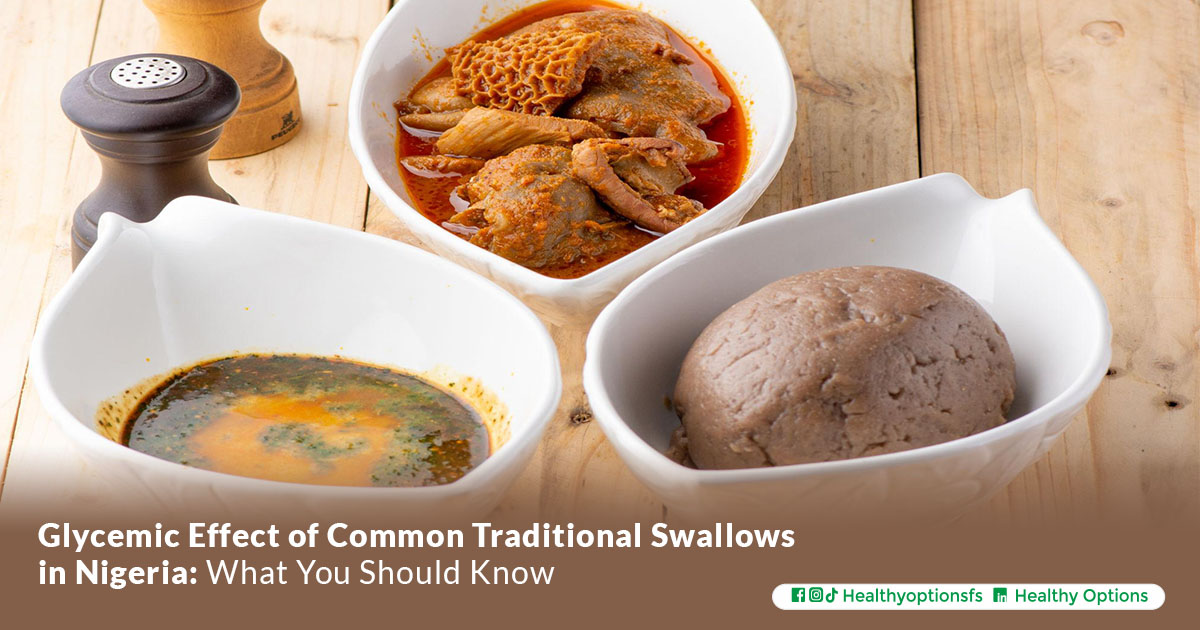
Glycemic Effect of Common Traditional Swallows in Nigeria: What You Should Know
Introduction
Traditional swallow staples are deeply woven into the fabric of our culture and ethnic diversity. However, when consumed in excess, many of these staples may pose challenges to our health due to their high glycemic effect and calorie density.
Understanding the Glycemic Effect
The glycemic effect describes how carbohydrate-containing foods impact blood glucose levels after a meal. Simply put, the higher the glycemic effect, the sharper the spikes in post-meal blood sugar. Two major food markers measure this response:
- Glycemic Index (GI): Classifies foods based on how quickly they raise blood sugar (Low: ≤ 55, Medium: 56–69, High: ≥ 70).
- Glycemic Load (GL): Accounts for both the quality (GI) and the total amount of carbohydrates in a standard serving (Low: ≤ 10, Medium: 11–19, High: ≥ 20).
Foods with a high GI and GL are typically starchy, low in fiber, and responsible for rapid spikes in postprandial blood glucose.
Traditional Swallow Staples in Nigeria
Most swallow staples consumed across different parts of Nigeria are heavily starchy and carry a high GI and GL. Common examples include:
- Yam or cassava flour (Amala)
- Garri (Eba)
- Pounded fermented cassava (Fufu/Akpu)
- Pounded yam (Iyan)
- Rice dough (Tuwo Shinkafa)
- Maize dough (Tuwo Masara)
Only a few local options, which remain largely unpopular, offer a lower glycemic effect. While metabolizable carbohydrate content largely dictates the glycemic response, food processing techniques, such as fine grinding and milling, also contribute by reducing particle sizes, prompting faster starch gelatinization, and increasing GI values.
Glycemic Indices of Commonly Consumed Indigenous Mixed-Swallow Meals
In Nigerian cuisine, swallow staples are rarely eaten alone; they are traditionally paired with high-fiber vegetable soups and a source of animal protein. This combination significantly lowers the overall glycemic effect compared to eating the swallow in isolation. The presence of dietary fiber from vegetables, alongside protein and fats, slows down stomach emptying and delays how quickly sugar is absorbed into the bloodstream. Nonetheless, a 2020 study evaluating the glycemic effect of commonly consumed mixed-meals among young adults in southwest Nigeria revealed that even with these moderating combinations, their overall GI often remains > 70.
Practical Implications for Your Health
Whole, nutrient-dense foods (such as whole grains, fruits, vegetables, and legumes) are renowned for lowering the risk of unhealthy weight gain and chronic diseases. They also play a vital role in managing diabetes mellitus (DM).
Because our local swallow staples are high in GI, carbohydrates, and calories, the key is balance: they should be consumed mindfully, in moderation, and thoughtfully paired with robust glycemic-lowering components (ample fiber, lean protein, and healthy fats).
Conclusion
The enjoyment of swallow foods is an essential part of our cultural identity and personal preference; and that is something we certainly don’t need to take away. Instead, our choices should be scientifically guided to curb the national burden of obesity, combat obesity-related chronic diseases, and better support the management of DM.
We’d love to hear from you: What are your favorite swallow foods, and how do you typically combine them? Share your thoughts and healthy tips in the comment section below!
References
- Okoduwa S. I., & Abdulwaliyu I. 2023. Dietary approach for management of type-2 diabetes: an overview of glycemic indices of commonly consumed foods in Nigeria. Diabetes and metabolic syndrome: Clinical Research & Review, 17(1). https://doi.org/10.1016/j.dsx.2022.102698
- Ogundele A. E. 2020. Glycemic indices of commonly consumed mixed meals ‘as eaten’ by apparently healthy young adult in southwest Nigeria. PhD Thesis, The Department of Human Nutrition, University of Ibadan.
- Omoregie E. S. & Osagie A. U. 2008. Glycemic indices and glycemic load of some Nigerian foods. Pakistan Journal of Nutrition, 7(5): 710-716.
- Asinobi C., Uzoagba, H., Mba-Anyadioha A., & Johnkennedy A. 2016. Glycemic index of some traditional fortified staple meals on the postprandial glucose responses of Nigerian undergraduate students: an open-label study. Functional Foods in Health and Disease, 6(7): 414-424.
- Abdulkadir D. M., Jibril A. A., Kano A. M., Hafiz A., & Mashi A. J. 2025. Glycemic indices and glycemic loads of some commonly consumed traditional diets in northwestern Nigeria. European Journal of Nutrition and Food Safety, 17(6): 43-52. https://doi.org/10.9734/ejnfs/2025/v17i61738
- Myke-Mbata B. K., Meludu S. C., Dioka C. E., & Amah U. K. 2021. Glycemic Index of commonly eaten dough staple foods among diabetics and non-diabetics in Makurdi. West J Med & Biomed Sci, 2, 1. https://doi.org/10.46912/wjmbs.41





Add comment